
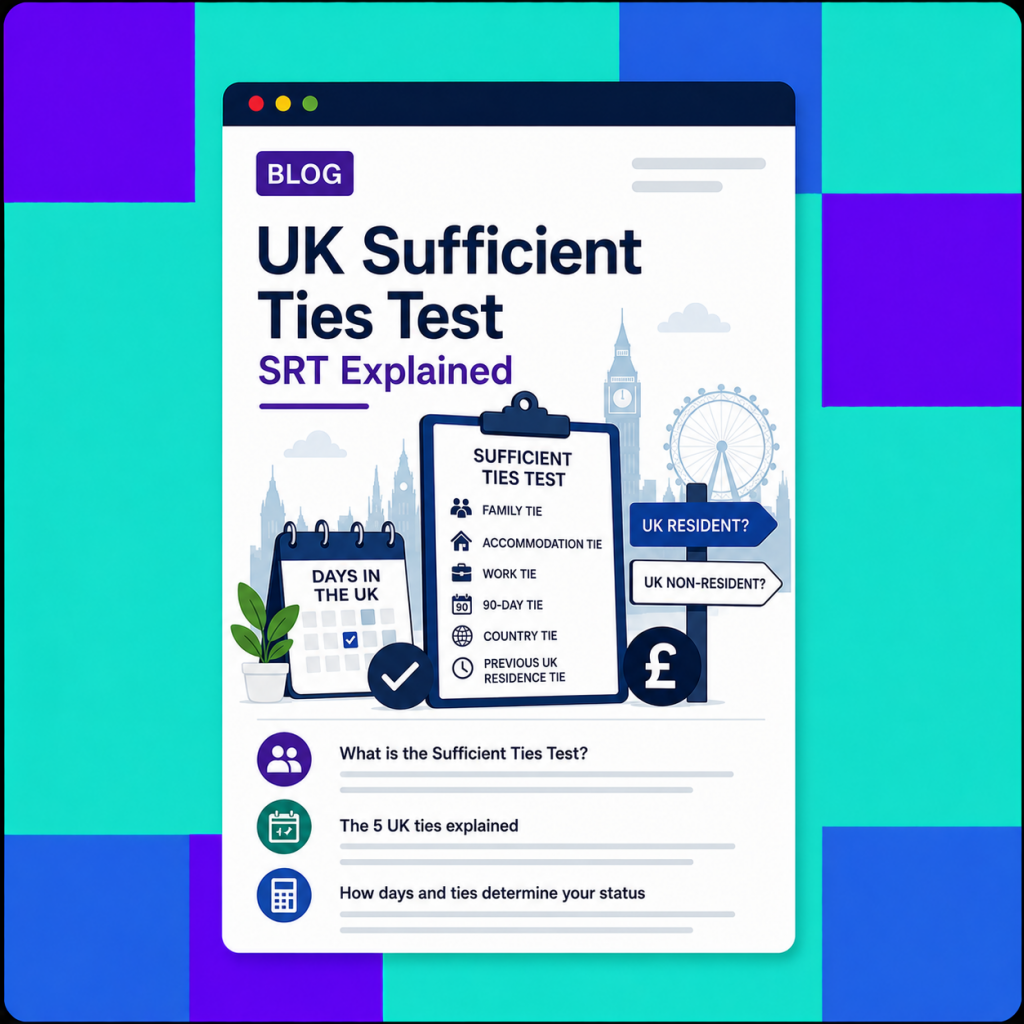
The Statutory Residence Test (SRT) is the set of UK rules used to determine whether an individual is UK tax resident for a particular tax year. If you are unfamiliar with the SRT or want to see how the tests link together, please see our complete guide to the Statutory Residence Test.
The SRT contains the following three sections:
- The UK automatic overseas tests
- The UK automatic residence tests
- The sufficient ties test
However, the tests are applied in a specific order. The first automatic UK test considers whether you have spent 183 days or more in the UK during the tax year. If you have, you are automatically UK tax resident and no further SRT tests need to be considered.
If you have spent fewer than 183 days in the UK, the automatic overseas tests are then considered. If you do not meet any of the automatic overseas tests, the second and third automatic UK tests are considered. If none of the automatic UK tests apply, the sufficient ties test is then used to determine your UK tax residence status.
This guide focuses specifically on the third and final section of the SRT; the UK sufficient ties test. This test considers your ties to the UK to produce a threshold of days. If you spend at least that many days in the UK in the tax year you are UK tax resident and fewer than this threshold you are UK tax non-resident for the full tax year.
As the UK sufficient ties test is the final section of the SRT, it only applies if you do not meet any of the UK automatic overseas tests or any of the UK automatic residence tests.
Although this guide provides an overview of the UK sufficient ties test, determining UK tax residence can be complex and depends on your individual circumstances. We recommend obtaining specialist advice to assess and confirm your UK tax residence status.
For further information or a complete professional assessment of your UK tax residence position, please contact Expat Tax Solutions.
Table of Contents
ToggleWhy Is My Residence Status Important?
UK tax residence is the key driver behind how your income is taxed in the UK and how it should be reported.
UK tax residents are taxable on their worldwide income and gains whereas non-residents are taxable in the UK only on their UK sourced income and UK property gains.
For individuals with income or gains arising in multiple jurisdictions, or for individuals who work internationally, the difference in their UK tax liability as a resident compared to a non-resident can be extremely significant.
The Five UK Ties Summarised
Under the UK sufficient ties test there are five ties that an individual can have:
90 Day Tie
An individual has this tie if they were present in the UK for at least 90 days in either of the previous two UK tax years.
A day of UK presence is any day on which the individual is present in the UK at midnight.
Work Tie
An individual has this tie if they exercised at least 40 UK workdays during the tax year.
A UK workday is any day on which the individual performs at least 3 hours of work while in the UK.
Family Tie
An individual has this tie if their spouse, civil partner, partner they are living with as a married couple, or child under the age of 18 is UK tax resident in their own right during the tax year.
The individual will not have a family tie with a child who is under the age of 18 if they spend time with that child in person in the UK on fewer than a total of 61 days in the tax year concerned. If the child becomes 18 during that tax year, the individual will not have a family tie in respect of that child if they have seen the child on fewer than 61 days in the UK in the part of the year before the child’s birthday.
Any day or part day that the individual sees their child in person in the UK counts as a day on which they see their child in the UK.
Accommodation Tie
An individual has this tie if they have accommodation in the UK available to them for at least 91 consecutive days during the tax year and they spend at least 1 night at the accommodation or at least 16 nights if the property belongs to a close relative.
Country Tie
An individual has this tie if they were UK tax resident in at least 1 of the previous 3 UK tax years and they spend more days in the UK than any other single country during the tax year.
The UK Sufficient Ties Test Days Threshold
The number of days you can spend in the UK before becoming UK tax resident depends on the number of ties you have and whether you were UK tax resident in at least 1 of the prior 3 UK tax years.
Table A applies if you were UK tax resident in at least 1 of the prior 3 tax years
| Days spent during the UK in the tax year | Minimum UK ties required |
|---|---|
| 16 - 45 | At least 4 |
| 46 - 90 | At least 3 |
| 91 - 120 | At least 2 |
| More than 120 | At least 1 |
Table B applies if you were UK tax non-resident in all of the prior 3 tax years
| Days spent in the UK during the tax year | Minimum UK ties required |
|---|---|
| 46 - 90 | All 4 |
| 91 - 120 | At least 3 |
| More than 120 | At least 2 |
You may notice that Table A doesn’t consider individuals with fewer than 16 days in the UK and Table B doesn’t consider individuals with fewer than 46 days in the UK. This is because those individuals will be UK tax non-resident for the entire tax year under the UK automatic overseas tests and therefore the UK sufficient ties test is not applicable.
UK Tax Reporting Requirements
UK tax residents are generally within the scope of UK tax on their worldwide income and gains, although specific rules and reliefs may apply depending on the individual’s circumstances. For example, eligible new UK residents may be able to claim relief under the Foreign Income and Gains (FIG) regime.
UK Self-Assessment Tax Return
Not all individuals are required to file a UK self-assessment tax return however UK tax residents may be required to file a Self Assessment tax return depending on their income, gains and circumstances. This can include individuals with income or gains that have not had tax deducted at source, or individuals making claims under the Foreign Income and Gains (FIG) regime or for certain forms of double taxation relief.
Record Keeping
UK tax residence is an area that HMRC may scrutinise when reviewing a tax return. As the SRT relies heavily on where you spend your time, your homes and, where relevant, your working pattern, it is important to retain appropriate evidence supporting your residence position.
This can include flight bookings and immigration records, evidence relating to your homes, meeting records and office attendance data.
We recommend retaining records supporting your UK tax residence position for at least five years from 31 January following the end of the tax year. For example, records relating to the 2026/27 UK tax year should be retained until at least 31 January 2033.
The UK Sufficient Ties Test FAQs
What is the UK sufficient ties test?
The UK sufficient ties test is the final part of the Statutory Residence Test (SRT) used to determine an individual’s UK tax residence status where neither the automatic overseas tests nor the automatic UK residence tests have determined the individual’s residence status.
It is therefore important that the different sections of the SRT are applied in the correct order.
What are the UK sufficient ties?
There are five possible UK ties that an individual can have:
- 90 day tie
- Work tie
- Family tie
- Accommodation tie
- Country tie
How many UK ties can I have before I become UK resident?
The number of UK ties you can have before becoming UK tax resident will depend on how many days you have spent in the UK during the tax year and whether you were UK tax resident in any of the previous 3 UK tax years.
The combination of days spent in the UK and prior UK residence determines the specific number of ties that apply to your situation.
How does the sufficient ties test work if I was UK resident in previous tax years?
If you were UK tax resident in at least one of the previous 3 tax years, the total number of days you can spend in the UK before becoming UK tax resident is lower compared to someone who was non-resident in all of the 3 previous tax years.
This is shown in the two separate tables above used to determine residence under the UK sufficient ties test.
How many days can I spend in the UK before I become tax resident?
There is no single number of days that applies to everyone. Depending on your circumstances and residence history, you can be UK tax resident with as little as 16 days in the UK.
Conversely, you can remain UK tax non-resident with as many as 182 days in the UK and so it is important that a full residence assessment is performed on a case by case basis, taking into account your specific circumstances.
What is the 90-day tie under the UK Statutory Residence Test?
You will have the 90 day tie if you were present in the UK at midnight on at least 90 days in either of the previous two tax years.
For individuals leaving the UK, it is therefore common for them to retain this tie until their third year outside of the UK.
Can I be UK tax resident without spending 183 days in the UK?
Yes. It is true that you will be UK tax resident if you spend at least 183 days in the UK in the tax year however you can be UK tax resident with as few as 16 days in the UK in the year.
Whether you become UK tax resident with fewer than 183 days will depend on your circumstances and the number of UK ties you have.
Does the sufficient ties test apply to people arriving in or leaving the UK?
The UK sufficient ties test can apply to both individuals arriving in the UK and individuals leaving the UK, provided neither the automatic overseas tests nor the automatic UK residence tests determine their residence status.
The way the sufficient ties test applies depends on the individual’s previous UK tax residence. Different thresholds apply to “arrivers” who were non-resident in the previous 3 tax years and “leavers” who were UK resident in at least 1 of those years.